Granite, natural hard stone - a material made for high precision
Weighing several tons, but precise enough for microns – the finest properties in measurement technology
Natural granite is an alkaline abyssal rock formed over hundreds of thousands of years from melted material in the earth’s crust. Owing to the way it was formed, it is very strong, extremely homogeneous, finely porous and has a tight structure. Because of these properties, granite has low thermal expansion and conductivity. It’s almost completely free of tension and its form remains constant over a long period of time. The material also boasts a high resistance to abrasion.
These specifications make granite into a base material created specifically for precision measuring tools and machine parts. The crystalline structure results in excellent grinding and lapping potential. The thermal expansion coefficient is very low in comparison to metallic substances. The stone is also naturally free of corrosion, allowing you to save time instead of spending it on caring for and degreasing the stone.
How does granite form?

Granite, in its diverse manifestations and compositions, formed millions of years ago under the earth’s crust, where magma slowly solidified. The magma was located under the earth’s surface at a depth of over 2 kilometers. For this reason, granite is considered an alkaline abyssal rock. Its technical term is “PLUTONIC ROCK”.
Due to tectonic motion and the erosion of surface stone, solidified granite came to the surface, where it’s now mined at large quarries around the world.
These formation processes are still taking place today. However, it takes another 10 to 15 million years before the solidified, natural stone hardens into the granite we can use, with all its characterisic properties.
Origin, mining, quality assurance
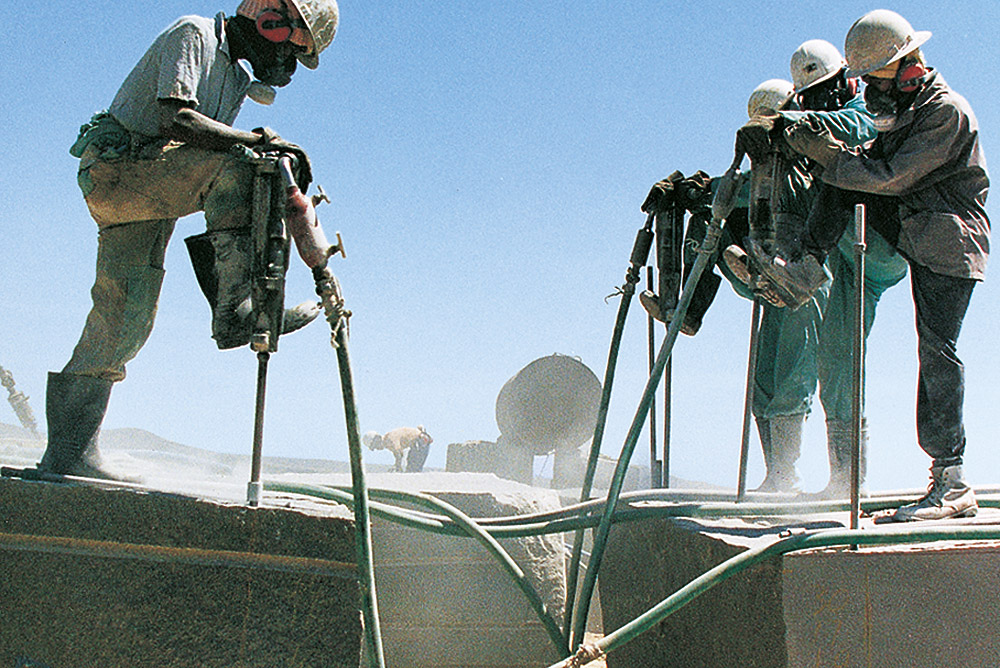
Stones that meet our requirements are mined primarily in Europe, Asia and Africa. We work closely together with quarries in France, Asia and South Africa. Due to this fact, its supply can be classified as relatively stable.
We choose granite of the most uniform structure possible for our products. All blanks undergo a strict selection process, where any actual defects are sorted out systematically.
However, the blanks may still exhibit variations in color. As with all natural materials, our stone has also been influenced by a variety of factors such as immense pressure and temperatures. They have changed, formed and made it into the material that we refine today. These processes aren’t carried out in “clean room conditions”, but in nature. Deviations in color may result from this. These however have no influence on the physical properties of the material and do not affect its accuracy.
Important Data on natural granite
| bulk density | 2.99 kg/dm³ |
| elastic modulus | 100,000 – 120,000 N/mm² |
| compression strength | 280 N/mm² |
| bending strength | 13 - 22 N/mm² |
| thermal expansion | 0.69 mm/m/100°C |
| linear expansion coeffizient | 5 - 7.5 x 10 ↑-6 /K |
| abrasion resistance | 4 - 10 cm³ / 50 cm² |
| water retention | 0.1 % - 1 % |
| available dimensions | max. 7 m³ |
| frost | resistant |
| environmental aggressors | resistant |
| finishr | durable |
| Poisson ratio | 0.11 - 0.25 |
| conductivity | 2.8 W/(m*K) |
 For design engineers
